
Services
Fire Fighting System
Automatic Water Sprinkler System
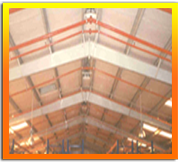
One of the oldest & traditional ways of fire protection, which is water based protection system, is in the form
of automatic sprinklers. EAPL can provide you with complete designing of sprinkler system for any kind of hazard. Our design
facility also has the provision for calculation of water demand using latest licensed hydraulic calculation software’s which will
accurately determine the water demand as per the standards.
Various sprinkler system network designing can be done to
cater the specific needs of the customers varying from residential to commercial and industrial.
Manual Fire Hydrant System

Depending on the type of hazard, different varieties and sizes of fire extinguishers
are located per standards which form typical manual fire protection systems. Also semi-automatic water based systems are classified
as manual fire protection systems. In this case the water under pressure will be available in the pipe line. The valves (normally
with 1.5� outlets within the building) have to be opened & hoses pulled down to fight the fire. The landing valves & fire hose
cabinets are provided for the use of occupants to fight small fires.
Hydrants (normally with 2.5� outlets located
outside the building) & fire hose houses are provided for the usage of trained fire fighters. These are the most common but
effective systems which we design on daily basis per standards & using hydraulic calculations.
Automatic Water Sprinkler System
One of the oldest & traditional ways of fire protection, which is water based protection system, is in the form
of automatic sprinklers. EAPL can provide you with complete designing of sprinkler system for any kind of hazard. Our design
facility also has the provision for calculation of water demand using latest licensed hydraulic calculation software’s which will
accurately determine the water demand as per the standards.
Various sprinkler system network designing can be done to
cater the specific needs of the customers varying from residential to commercial and industrial.
Manual Fire Hydrant System
Depending on the type of hazard, different varieties and sizes of fire extinguishers
are located per standards which form typical manual fire protection systems. Also semi-automatic water based systems are classified
as manual fire protection systems. In this case the water under pressure will be available in the pipe line. The valves (normally
with 1.5� outlets within the building) have to be opened & hoses pulled down to fight the fire. The landing valves & fire hose
cabinets are provided for the use of occupants to fight small fires.
Hydrants (normally with 2.5� outlets located
outside the building) & fire hose houses are provided for the usage of trained fire fighters. These are the most common but
effective systems which we design on daily basis per standards & using hydraulic calculations.
Fire Pumps & Water Tanks

For all water based & foam based, automatic or semi automatic fire protection
systems the water will be available under pressure at all times. This is achieved by providing fire pump set and water tank, all
inter connected. Generally there will be an electric motor driven main fire pump, the size (flow & pressure) of which is based on
the highest demand from hydraulic calculations. There will be a stand by Diesel engine driven fire pump of same capacity for
emergency purpose. Additionally there will be a pressure maintaining device also called as a Jockey pump whose pressure rating
will be equal to that of the main pump but with a very low flow rate. Other mandatory accessories will all be fitted together &
the inlet connected to a dedicated fire water tank.
The capacity of the tank depends on the hazard nature which
defines the time period required multiplied with the flow of the main fire water pump. All of these again needs experienced
engineers to design an optimum package meeting the standards, yet economically viable. The team at EFS has this in abundance with
right tools to execute in a very quick time.
Deluge System

As the name indicates, flooding the entire hazard area with huge quantity of water
(could be foam too) is known as deluge systems.
These systems are sometimes used for extinguishment, sometimes for
control of fast spreading fires & sometimes as surface cooling. Applications are wide & mechanism of operation are also multiple
like wet pilot actuation, dry pilot actuation, electrical actuation, manual actuation & these sometime combine with single pre
action & double pre action thus making it again the need of skilled & experienced Engineers to understand, engineer & design the
specifically required system for water or foam again by running multiple hydraulic calculations.
EFS again is proud to
have a team of people who have designed installed & successfully commissioned hundreds of such systems.
Gas Suppression System

These systems also known as clean agent systems are widely used where the
environment needs no tedious cleaning after the extinguishment of fire like computer rooms, control rooms, record rooms, libraries,
electrical hazards such as switchgear rooms, substations, battery rooms etc. Carbon dioxide systems are generally used for
unmanned areas since it could be lethal for human beings though it is economical & one of the best agent for extinguishing the
fire. Low pressure CO2 systems (360 psi) are used where the quantity of the gas required is high as it is available with tanks
from 1 ton to 10 tons& comes with its own refrigeration unit to store CO2 in its liquid form. High pressure CO2 systems (850 psi)
are used where the quantity of gas required is small as they are available in standard bottles of 60, 80 & 120 lbs. capacity
wherein the gas is stored under high pressure at normal ambient temperature. Inergen systems are the evolution of new clean
agent systems after the ban on Halon systems. It kills the fire by inerting the hazard with huge quantity of inert gas like
Nitrogen. The initial fill & refill of gas is very economical though the storage cylinders & their maintenance might be an
expensive affair. FM200 (trade name) is one of the most successful replacement of Halon systems where it is human friendly & not
having the ozone depletion potential. It is stored under pressure of Nitrogen at about 360 psi.
Sapphire/Novec is
one of the new replacements for Halon systems which is again human friendly, zero ozone potential & no global warming. Easier
to handle as it is in its liquid form at normal ambient temperature & flows easily as compared to FM200. Designing of above
mentioned gaseous fire protection systems needs highly skilled, competent & preferably factory trained personnel as they
involve high tech equipment with high pressures & involves flow calculations on special software which are generally provided
by the manufacturers. At EAPL we have the team with above qualification & who have the experience of designing, erecting &
successfully commissioning, hundreds of such systems. We have the necessary software too for running the calculations.
Low Voltage Systems
Fire Alarm System

Today the fire alarm
system has evolved a long way. Hence the designing of Advanced Intelligent Fire Alarm Systems as per International standards is a
challenge which EAPL can easily accept & successfully accomplish.
The designing of Fire Alarm System is not only limited to providing a conceptual design, but we also provide actual design drawings
which includes Shop Drawings, Installation drawings, Wiring Diagram, Input/output Configuration which will help the installer to
install the system accurately. Our design will be customized as per the various manufactures of the systems.

Digital Voice Evacuation is an extension of fire alarm system which is integrated with fire alarm system to provide occupants with digitally prerecorded messages to help them evacuate in case of emergency. In a huge facility one system may not be sufficient, hence it is required to use many fire alarm systems, all of which can be networked as an integrated system with information available at single window. Our design team of EAPL has designed & successfully delivered many such complex projects. EAPLoffers designs for Network Integrated Systems using traditional wired technology, Optic fiber technology, IP based Networking using CAT 5 Wire or Wireless
Public Address System

As the name indicates, flooding the entire hazard area with huge quantity of water
(could be foam too) is known as deluge systems.
These systems are sometimes used for extinguishment, sometimes for
control of fast spreading fires & sometimes as surface cooling. Applications are wide & mechanism of operation are also multiple
like wet pilot actuation, dry pilot actuation, electrical actuation, manual actuation & these sometime combine with single pre
action & double pre action thus making it again the need of skilled & experienced Engineers to understand, engineer & design the
specifically required system for water or foam again by running multiple hydraulic calculations. EFS again is proud to have a team
of people who have designed installed & successfully commissioned hundreds of such systems.
© All right reserved by Electromech Fire System. Designed by MX Creativity.